
The Great 'Context vs. Reasoning' Debate: Making Sense of March 2026's AI Model Surge
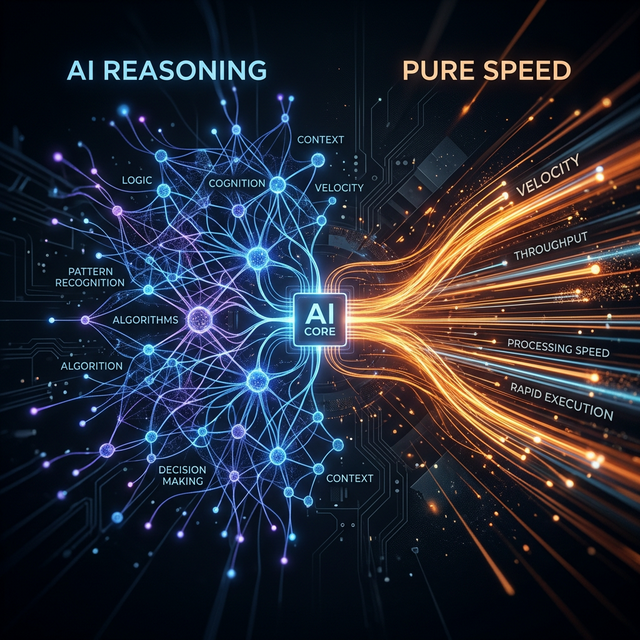
March 2026 brought a flurry of foundational model updates. We break down the divergent strategies behind Claude 4.6, GPT-5.3 'Garlic', and Gemini 3.1 Flashlight.
The first few weeks of March 2026 have delivered a whirlwind of announcements across the top AI ecosystems. rather than moving in lockstep, the major players are taking distinctly different approaches to closing the gap between raw compute and enterprise utility.
Anthropic's Claude 4.6: "Adaptive Thinking"
Anthropic's latest release introduces Claude Opus 4.6, featuring a new capability dubbed "adaptive thinking." Unlike previous models where users had to explicitly prompt for step-by-step reasoning or select a reasoning-focused tier, Opus 4.6 dynamically gauges the complexity of a prompt. It automatically allocates additional reasoning time for complex logic puzzles or deep code refactoring, while answering simple factual questions instantly.
For enterprise developers, this means less time spent tweaking prompt engineering and routing logic—the model effectively self-regulates its compute budget based on the task at hand.
OpenAI's GPT-5.3 "Garlic": Cognitive Density over Scale
OpenAI unveiled GPT-5.3 "Garlic" alongside a faster counter-part, GPT-5.3 Instant. The standout feature here is what researchers are calling "cognitive density." Rather than simply increasing the parameter count into the multi-trillions, OpenAI has utilized an Enhanced Pre-Training Efficiency approach.
The result is a model that boasts six times more knowledge density per byte. By focusing on how densely information and logic are packed within the neural weights, GPT-5.3 requires significantly less memory overhead during inference, driving down costs without sacrificing reasoning capabilities.
Google's Gemini 3.1 Flashlight: The Need for Speed
Not to be outdone, Google released Gemini 3.1 Flashlight, explicitly targeting the high-volume, low-latency market. Billed as the fastest and most cost-efficient model in the Gemini 3 lineup, Flashlight is designed for real-time applications such as live transcription analysis, high-concurrency customer support agents, and edge deployments.
What This Means for Business Leaders
- Stop agonizing over the "best" model: Model capabilities are converging, but optimization strategies are diverging. The choice is no longer just about benchmarks; it's about matching the model's architectural strength (e.g., adaptive reasoning vs. cognitive density vs. raw speed) to your specific workflow.
- Agentic routing is more important than ever: As models specialize in their operational profiles rather than just their size, the value of robust orchestration logic (like Genkit) increases. You want the ability to route a complex strategic query to Claude 4.6, while handling thousands of basic user interactions via Gemini 3.1 Flashlight.
- Infrastructure constraints are defining model design: The push for "cognitive density" by OpenAI indicates a shift. The era of brute-forcing parameter counts is giving way to optimizing for GPU memory bandwidth and inference efficiency.
As the "AI Periodic Table" expands, the focus for organizations must shift from tracking every model release to building flexible, modular architectures that can seamlessly integrate whichever model best fits the task at hand.



Discussion
0Join the conversation
Sign in with your Google account to participate in the discussion, ask questions, and share your insights.